Dead Air Doesn't Lie: What Celebrity Interview Pauses Are Actually Telling You
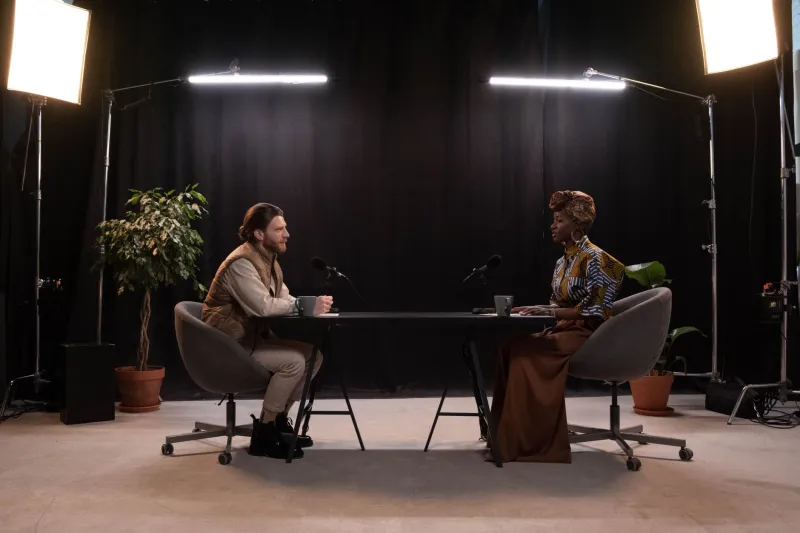
There's a moment you've definitely seen before. The host leans forward, asks that question — the one about the ex, the feud, the rumor that's been eating up everyone's feeds — and the celebrity just... stops. Their eyes shift. A breath happens. Maybe a smile that doesn't quite reach the right muscles. Then finally, words come out.
Most people clock that pause as awkward and move on. But if you know what you're looking at, that silence is the loudest part of the entire interview.
Welcome to the thing nobody in the industry wants to explain out loud.
The Pause Is a Production Decision, Not an Accident
Here's what most casual viewers don't realize: televised celebrity interviews are not raw, unfiltered exchanges. They are edited, shaped, and in many cases, strategically restructured before they ever reach your screen. Late night shows, morning talk formats, even the prestige sit-downs that feel intimate and confessional — all of it goes through a post-production process where producers make very deliberate choices about what stays in, what gets cut, and crucially, how long a pause lingers.
That extra beat of silence before a celebrity responds? Producers can stretch it. A pause that lasted maybe a second in the actual room can become two and a half seconds on your screen — long enough to feel genuinely uncomfortable, long enough for your brain to start filling in the gaps with assumptions.
This is not accidental. Discomfort is engaging. Tension keeps eyes on screens. And a well-placed reaction shot — the host's raised eyebrow, the nervous laugh, the camera catching a blink at exactly the wrong moment — can reframe an entire response before the celebrity even opens their mouth.
What the Body Does When the Voice Goes Quiet
Psychologists who study nonverbal communication have a term for the split-second period before someone answers a loaded question: the pre-response window. It's the gap between stimulus and speech, and it's one of the most honest moments a person can have on camera — precisely because most people haven't trained themselves to control it.
Celebrities, of course, are better at this than most. Years of press junkets, media training, and carefully managed public personas mean that many of them have developed a kind of controlled blankness — the ability to appear neutral while internally deciding which version of the truth to serve up.
But even the most media-trained celebrity has tells.
A pause accompanied by a downward gaze often signals that the person is accessing memory — or constructing one. A pause with sustained eye contact and a slow exhale typically reads as someone buying time while maintaining the performance of confidence. And then there's the smile-pause combo, which is its own subspecies entirely: the smile goes up, the eyes don't follow, and the words that eventually come out are almost always some variation of deflection dressed as warmth.
Watch any high-stakes celebrity interview from the last five years with the sound off for thirty seconds. You'll start seeing a whole different conversation.
The Shade That Never Gets Said
Some of the most effective celebrity shade in modern media history has been delivered in complete silence.
Think about the interviews where someone is asked directly about a co-star they famously clashed with. The question lands. There's a pause. Then: "I think she's incredibly talented." Said slowly. With a smile that has more teeth than warmth. Followed immediately by a subject change.
That pause before the compliment? That is the shade. The words that follow are technically positive. But the architecture of that moment — the delay, the precision of the phrasing, the almost surgical absence of anything personal or warm — communicates everything the celebrity legally and professionally cannot say out loud.
This is a skill, and some celebrities have mastered it to an almost artful degree. The pause becomes a kind of punctuation mark that recontextualizes whatever comes after it. It says: I am choosing these words very carefully, and I need you to know that I'm choosing them carefully.
How Talk Show Producers Engineer the Moment
It's worth understanding the machinery behind these interviews, because the silence you're watching was often set up long before the cameras rolled.
Producers and publicists negotiate the terms of interviews in advance. There are approved topics, off-limit zones, and sometimes even pre-agreed question sequences. What this means in practice is that when a host asks something that feels spontaneous and slightly dangerous, the celebrity almost always knew it was coming. The pause, in that context, is not raw discomfort — it's performance.
But here's where it gets interesting: even a performed pause reveals something. The quality of a rehearsed silence is different from a genuine one. Rehearsed pauses tend to be cleaner, more symmetrical — a breath in, a beat, a breath out, then the answer. Genuine discomfort is messier. There's micro-movement. The eyes work harder. The pause doesn't have the same rhythm.
Learn to tell the difference and you're essentially reading behind the edit.
The Reaction Shot Is the Tell
One element of interview editing that rarely gets discussed outside of film school: the cutaway reaction shot. That moment where the camera swings to the host looking skeptical, or to an audience member with wide eyes, or back to the celebrity's face during a pause in someone else's sentence — these are inserted in post-production and they are editorial statements.
The original interview footage doesn't necessarily include that reaction at that moment. Producers pull from other footage taken during the same session and drop it in to create a specific emotional read. A celebrity might have paused for a completely mundane reason — a dry throat, a distraction off-camera — and a well-timed cutaway to a skeptical host turns that neutral pause into apparent evasion.
You are, in other words, often not watching the interview. You're watching a version of the interview that has been assembled to tell a particular story.
Decoding It in Real Time
So what do you actually do with all of this? Here's the practical part.
Next time you're watching a celebrity interview — especially one where the stakes feel high — try this: pay attention to the pauses that happen before the most positive-sounding answers. Effusive praise delivered after a noticeable hesitation is almost always more complicated than it sounds. Watch for what happens with the hands during silence. Watch for the moment when a celebrity's posture changes even slightly right before they redirect a conversation.
And if you can find the original broadcast footage versus a clipped version circulating on social media, compare them. The clips are almost always edited to emphasize specific pauses. The longer broadcast version will often tell a completely different story.
The silence between the words is where the real interview lives. The rest is just noise.