When the Curtain Slips: The Glitches, Gaps, and Giveaways That Prove Live TV Is More Constructed Than You Think
You're watching the Super Bowl halftime show. The performer is moving, the crowd is going absolutely wild, and then — for just a fraction of a second — something feels off. The mouth doesn't quite match the sound. The audio arrives a beat too late, or maybe too early. Your brain flags it, your eyes narrow, and then the moment passes like it never happened.
But it did happen. And that tiny glitch? It just told you more about how live television actually works than any behind-the-scenes documentary ever could.
The Millisecond That Breaks the Magic
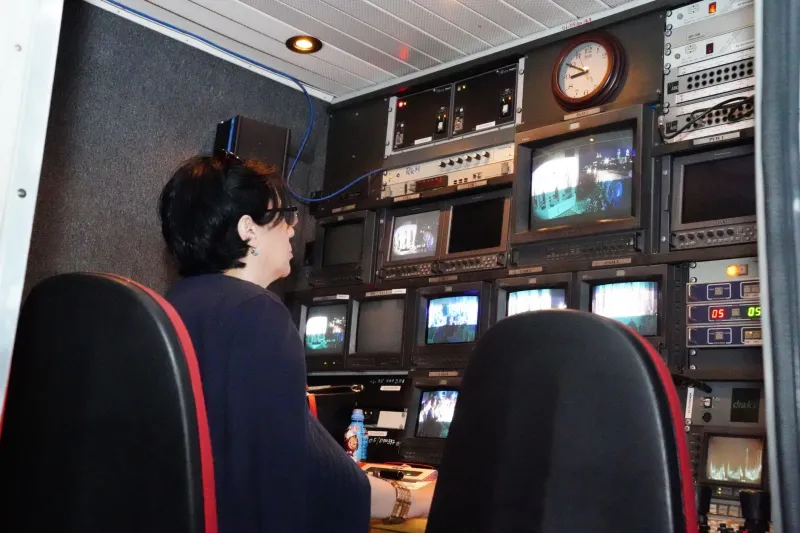
Audio-visual sync errors — the technical term is "lip-sync drift" — are one of the most revealing accidents that can happen during a live broadcast. They're caused by the massive, complicated chain of equipment that sits between a performer and your screen. Cameras feed into switchers. Switchers feed into encoders. Encoders push the signal through satellites or fiber lines. Every single hop in that chain adds a few milliseconds of delay, and audio and video don't always travel at the same speed through that chain.
Broadcast engineers spend enormous energy trying to compensate for this. But when they miscalculate — or when a last-minute equipment swap throws off the calibration — the gap becomes visible. And when it does, you're not just seeing a technical error. You're seeing proof that what you're watching has been processed, routed, and reconstructed before it ever reaches your eyes.
Here's the part that gets interesting: in many major live performances, the audio you're hearing isn't even fully "live" in the way most people assume. Performers often sing over a backing track, or use a hybrid method where some elements are pre-recorded and layered under a live vocal. This isn't a secret in the industry — it's standard practice, driven by the reality that truly unassisted live audio in a stadium or arena sounds, frankly, terrible. The acoustics are brutal, the wind is unpredictable, the crowd noise is overwhelming. So producers build a controlled version of the sound and use it as a foundation.
The glitch exposes the scaffolding.
Crew in the Frame, Cords on the Stage
Sync issues aren't the only way live TV accidentally unmasks itself. Anyone who's watched enough award shows or major network broadcasts has probably caught a stray crew member wandering into frame, a teleprompter reflection in someone's glasses, or a piece of staging equipment that wasn't supposed to be visible to the camera.
These moments are brief. Editors and directors are trained to cut away fast, and most viewers are so conditioned to trust the broadcast that their brains smooth over the error. But if you're paying attention — or if you happen to be screen-recording and can scrub back through the footage — those frames are genuinely illuminating.
They reveal that the "spontaneous" moment you just watched was blocked in advance. The camera knew where to be because someone told it where to be. The lighting that makes your favorite celebrity look ethereal is the result of a lighting director making real-time adjustments based on a pre-planned setup. None of this is inherently deceptive — it's just production — but it runs directly counter to the "you're here, in the moment, watching something real" feeling that live TV actively sells.
AI in the Control Room
Here's where things get genuinely strange, and recent. In the last few years, major broadcast networks have started incorporating AI-assisted tools into their live production pipelines. These tools do things like automatically adjust color grading in real time, smooth out audio inconsistencies, and in some cases, generate crowd noise or ambient sound to fill gaps.
Some sports broadcasts have used AI to enhance or even synthesize crowd reactions when the arena audio isn't clean enough. A few streaming platforms have experimented with real-time background replacement for live events — essentially green-screening a live stage to make it look more dramatic on camera than it actually does in person.
None of this is disclosed to viewers. And why would it be? The whole point is seamlessness. But it means that "live" increasingly means "live with a real-time layer of post-production running on top of it." The person performing is real. The audience is real. The emotion is real. But the version of those things that reaches your screen has been processed, enhanced, and in some cases partially reconstructed — all within the span of milliseconds.
Why the Glitch Feels Bigger Than It Is
When a sync error goes viral — and they do, regularly — the reaction is usually disproportionate. People act like they've been personally deceived. There are Twitter threads, Reddit breakdowns, think pieces. The performer gets accused of faking it. The network gets dragged.
But the outrage kind of misses the point. The issue isn't that one singer used a backing track at one awards show. The issue is that the entire framework of "live" television is built on a set of conventions and compromises that viewers aren't really invited to know about. The glitch doesn't reveal a scandal. It reveals a system.
And once you start seeing the system, you can't really unsee it. You start noticing the too-perfect audio on every major broadcast. You start wondering about the camera angles that always seem to anticipate the action. You start clocking the moments where the "spontaneous" crowd reaction lands just a little too clean.
What You're Actually Watching
The honest answer to "is this live?" is almost always: kind of. There's a real event happening in real time, and people are genuinely performing and reacting. But by the time that event reaches your screen, it's been routed through enough technology — and in some cases enough AI — that calling it unmediated feels like a stretch.
That's not necessarily a bad thing. Production exists for a reason. Raw, unprocessed live television is chaotic and often unwatchable. The craft of making it look and sound polished is legitimate and genuinely impressive.
But the illusion of pure, unfiltered liveness — the "you are there" feeling that networks have been selling since the dawn of broadcast television — is exactly that. An illusion. And every once in a while, when an audio signal arrives a half-second late and a performer's mouth drifts out of sync with the sound, that illusion cracks just enough to let you see through it.
Pay attention to those cracks. They're the most honest thing on your screen.